Evaluating Hand Holding Pen Continuous Line Art for Design Projects
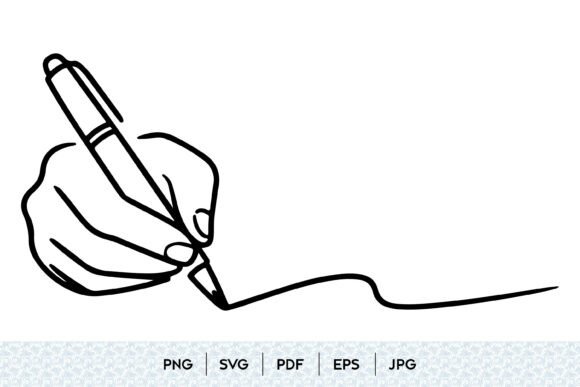
In the realm of graphic design and visual storytelling, the choice of illustration style can significantly influence how a message is received. One specific aesthetic that has gained traction across various industries is Hand Holding Pen Continuous Line Art. This minimalist approach utilizes a single, unbroken stroke to depict a hand gripping a writing instrument, actively engaged in the process of creation. For designers, educators, and brand strategists, understanding the nuances of this style is essential when determining its suitability for specific projects. This article evaluates the characteristics, applications, and practical considerations of using continuous line art featuring a hand and pen.
Defining the Aesthetic and Concept
At its core, Hand Holding Pen Continuous Line Art is defined by its economy of form. Unlike detailed realism or complex shading, this style relies on the fluidity of a single line to suggest shape, movement, and intent. The subject matter—a hand holding a pen—is universally recognized as a symbol of authorship, education, planning, and artistic expression. By rendering this subject in a continuous line, the image conveys a sense of flow and uninterrupted thought.
The visual result is clean and modern. It strips away non-essential details, focusing the viewer's attention on the action of writing or drawing itself. This abstraction allows the image to remain versatile; it does not dictate a specific era, gender, or cultural context, making it highly adaptable for global audiences. When evaluating this asset type, one must recognize that its power lies in what is omitted as much as in what is included.
Strategic Applications and Fit
Deciding whether to incorporate Hand Holding Pen Continuous Line Art into a project depends largely on the intended message and the medium of delivery. There are several scenarios where this specific style serves as a strong fit:
- Branding for Creative Professionals: Authors, illustrators, and consultants often require logos or portfolio headers that subtly communicate their trade without being literal or cluttered. The continuous line suggests elegance and sophistication, aligning well with personal branding efforts.
- Educational Materials: In textbooks, worksheets, or e-learning modules, clarity is paramount. This style provides a friendly, approachable visual cue for sections related to writing exercises, note-taking, or examinations without distracting from the text.
- Stationery and Print Products: The simplicity of the line work translates exceptionally well to physical products like business cards, notebooks, and greeting cards. It prints cleanly even at small scales and works effectively as a watermark or embossed design.
- Digital Interfaces: For websites and apps, SVG versions of this art load quickly and scale perfectly across devices. They serve as excellent icons for "blog," "contact," or "sign-up" sections.
In these contexts, the art acts as a functional element that enhances user experience or brand identity through subtlety rather than dominance.
Benefits of the Continuous Line Approach
There are distinct advantages to selecting Hand Holding Pen Continuous Line Art over more complex illustrations. Primarily, its minimalism ensures versatility. Because the design lacks heavy colors or intricate textures, it can be easily recolored to match any brand palette. A designer can change the stroke from black to a corporate blue or a vibrant orange with minimal effort, ensuring consistency across marketing materials.
Furthermore, the availability of such assets in multiple formats—typically including SVG, PNG, EPS, PDF, and JPG—facilitates seamless integration into diverse workflows. Vector formats like SVG and EPS allow for infinite scalability, which is critical for large-format printing or high-resolution displays. Raster formats like PNG and JPG offer immediate usability for web content where vector support might be limited. This flexibility reduces the technical barriers to entry for users who may not have advanced editing software.
From a psychological perspective, continuous line art often evokes a sense of calm and focus. In an era of information overload, the simplicity of a single line can provide a visual break, making content feel more accessible and less intimidating to the audience.
Tradeoffs and Limitations
While the benefits are significant, a balanced evaluation requires acknowledging the limitations. The primary tradeoff of Hand Holding Pen Continuous Line Art is the lack of detail. If a project requires depicting a specific type of pen, a particular hand gesture, or realistic anatomical features, this style will likely fall short. The abstraction inherent in continuous line drawing means that specificity is sacrificed for style.
Additionally, legibility can become an issue if the line weight is too thin or if the image is scaled down excessively for mobile screens. While vector formats mitigate resolution loss, the visual clarity of the loop and curves must be maintained to ensure the subject remains recognizable as a hand and pen. Over-simplification can sometimes lead to ambiguity, where the viewer might struggle to interpret the object immediately.
Another consideration is market saturation. Due to the popularity of minimalist line art, similar images are prevalent in stock libraries. Brands seeking a truly unique visual identity may find that generic continuous line assets do not differentiate them sufficiently from competitors unless customized heavily.
When to Consider Alternatives
There are situations where alternative illustration styles may better serve your goals. If the objective is to evoke nostalgia, warmth, or a hand-crafted feel, a sketch-style illustration with cross-hatching or watercolor textures might be more appropriate. Similarly, if the target audience is children, a more colorful, cartoonish, or bold outline style could engage them more effectively than the subtle sophistication of continuous line art.
For technical documentation requiring precise depiction of tools or ergonomic grips, realistic 3D renders or detailed technical drawings are superior choices. In these cases, the abstract nature of Hand Holding Pen Continuous Line Art would obscure necessary information rather than clarify it.
Practical Decision-Making Insights
To determine if this art style aligns with your needs, consider the following decision framework:
- Assess Brand Tone: Does your brand voice lean towards modern, sleek, and thoughtful? If so, continuous line art is likely a match. If your tone is playful, rugged, or traditional, look elsewhere.
- Evaluate Medium Constraints: Will the image be used primarily in digital environments where load speed matters, or in print where ink coverage is a concern? The low-ink nature of line art makes it cost-effective for printing, while SVGs optimize digital performance.
- Check Customization Needs: Determine if you need to modify the line weight or color frequently. Ensure the purchased or downloaded file includes editable vector sources (EPS or SVG) rather than flattened images.
- Define the Message: Ask yourself if the concept of "flow" and "creativity" is central to the message. If the focus is on the tool itself rather than the act of using it, a different visual approach may be required.
Ultimately, Hand Holding Pen Continuous Line Art is a powerful tool in the designer's arsenal when used with intention. It bridges the gap between functional iconography and artistic expression. By carefully weighing the need for simplicity against the requirement for detail, creators can leverage this style to enhance educational resources, strengthen branding, and inspire creativity in their audiences. Whether for a tattoo design symbolizing a writer's journey or a logo for a new publishing house, the continuous line offers a timeless representation of the human capacity to create.